How Much Does a Space Heater Cost to Run? The Real Math
When the cold snap hits, the space heater is the reflex — but how much does that comfort actually cost? The honest answer is simple math, not marketing: every 1500W electric heater burns exactly 1.5 kWh every hour it runs, regardless of brand, price or type.
The one equation that matters
Cost = watts × hours × your electricity rate. For a 1500W heater:
| Electricity rate | Per hour | Per 8-hour evening | Per 24h (don't) |
|---|---|---|---|
| ~17¢/kWh (US average) | ~$0.26 | ~$2.05 | ~$6.10 |
| ~7.8¢/kWh (Hydro-Québec Rate D) | ~$0.12 | ~$0.94 | ~$2.80 |
Your actual rate is on your bill. US residential rates average roughly 17¢/kWh (EIA), while Québec's hydro rate sits below 8¢/kWh — one reason Québec homes heat electrically and the math feels very different across the border we map live every 15 minutes.
When a space heater saves money — and when it doesn't
Saves money: you spend the evening in one room and let the whole-house system run cooler. Heating one occupied room with 1500W beats heating ten rooms for people who aren't there. This is zoning by other means, and it's the legitimate use case.
Costs money: the heater runs all day in an occupied house, fighting the central system, or in a badly drafty room where the heat escapes as fast as it's made. (If that's your situation, fix the room first — see our draft-proofing guide.)
The two picks worth buying
As an Amazon Associate, PowerTrip earns from qualifying purchases — details at the end of this guide.
DREO Space Heater (1500W PTC ceramic, ECO mode)
The feature that matters: an ECO thermostat mode that holds your set temperature by cycling the element off instead of running flat-out — which is exactly the run-time reduction the math rewards. Add a 12-hour timer, remote and quiet operation.
- Best for: bedrooms and offices where it cycles on a thermostat
- Standout: ECO mode + timer = paying for comfort, not idle burn
Lasko 751320 Ceramic Tower Heater (1500W)
A top seller for years for a reason: simple, oscillating, with overheat protection and a timer. Same 1500W physics as anything fancier — you're choosing features, not efficiency.
- Best for: budgets — get the heat, skip the extras
- Standout: proven design, widespread oscillation
Amazon prices shown at publish time; check the product page for the current price. All 1500W models cost the same per hour to run; prices shown are for the listed units.
Safety, briefly (it matters more than efficiency)
- Space heaters are involved in a disproportionate share of home heating fires. Keep 1 metre (3 feet) clearance from anything flammable.
- Never run one on a power strip — 1500W can overload cheap strips. Wall outlet only.
- Models with tip-over switches and overheat protection (like both picks above) are non-negotiable, especially around kids and pets.
Five mistakes that turn a space heater into a bill-burner
- Heating a room with the door open. The heater fights your whole house's volume instead of one room's. Close it, or the math below doubles.
- Using it while the main heat is also on in that room. Two heat sources in one room is not efficiency, it's a race. One, set a few degrees lower, with the space heater as the closer.
- Believing "energy-efficient" marketing on the box. Every 1500 W heater converts electricity to heat at the same rate — physics, not branding. What differs is air circulation, thermostat control, and safety features.
- Running it unattended or overnight on old units. Modern picks have tip-over cutoffs and cool-touch shells. 1990s-style bare-coil heaters belong retired.
- Ignoring where the heat actually goes. A heater on the cold side of the room pushes heat into the wall. Point it at where you sit.
What one hour of 1500 W actually costs
| Where you live | Approx. residential rate | 1,500 W for 1 hour | 8 h/day, 30 days |
|---|---|---|---|
| Québec (Hydro-Québec rate D) | ≈8¢/kWh | ≈12¢ | ≈$29 |
| US average | ≈17¢/kWh | ≈26¢ | ≈$61 |
| Ontario at peak hours | roughly 2× Québec's rate | ≈25–28¢ | ≈$60–67 |
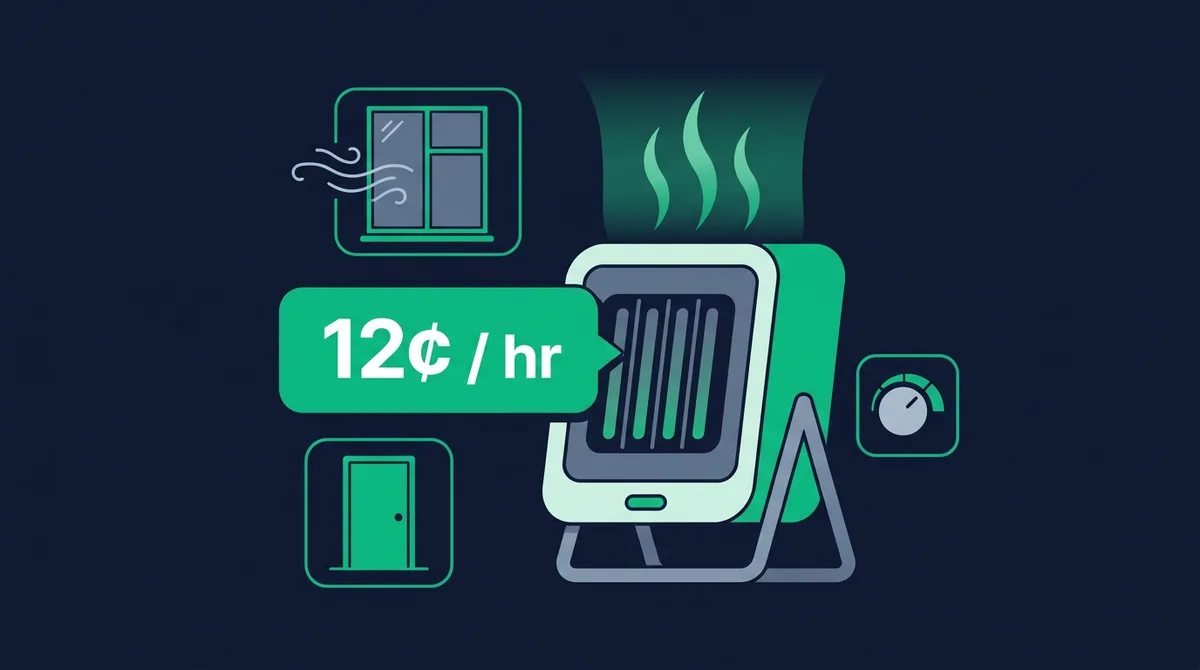
Check your own bill for the real number — these are planning figures, not quotes. The point stands: the room you heat, not the heater you buy, determines the cost.
The Québec nuance: in most of Québec, heating is electric baseboard — which means the space heater isn't competing against cheap gas, it's competing against your baseboards. That makes the "heat one closed room well instead of a whole apartment weakly" strategy unusually effective here: same electricity, less of it, more comfort.
How much does a 1500W space heater cost to run?
All 1500W space heaters use exactly 1.5 kWh per hour. At a typical US residential rate of about 17¢/kWh, that's roughly 25¢ per hour — about $6 per day if it ran around the clock. At Québec's Hydro-Québec rate (under 8¢/kWh), the same heater costs closer to 12¢ per hour.
Are more expensive space heaters cheaper to run?
No — and this is the most common misconception. A 1500W heater costs the same to run whether it cost $30 or $200. What a better model can change is how long it needs to run: thermostat controls, ECO modes and better airflow distribute heat more evenly, so it cycles off sooner.
Is a space heater cheaper than heating the whole house?
Sometimes, if you'd otherwise heat empty rooms. Zoning one occupied room with a space heater while letting the central system run at a lower setpoint can reduce total energy use. But a space heater running flat-out 24/7 costs more than efficient central heating — it all depends on how you use it.